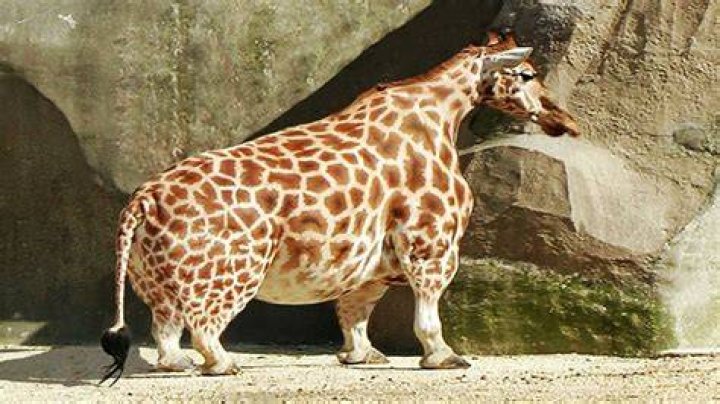
Can animals get dwarfism?
 Rachel Hernandez
 .
Also to know is, can Lions have dwarfism?
Any mane that a male tigon may have will appear shorter and less noticeable than a lion's mane and is closer in type to the ruff of a male tiger. It is a common misconception that tigons are smaller than lions or tigers.
| Tigon | |
|---|---|
| Phylum: | Chordata |
| Class: | Mammalia |
| Order: | Carnivora |
| Suborder: | Feliformia |
One may also ask, are there dwarf tigers? There are several subspecies of tiger, including the Bengal tiger, Siberian tiger, and Java tiger. The smallest subspecies ever described is the Balinese tiger. These lived on the island of Bali in Indonesia.
Also asked, can dogs be born with dwarfism?
Shedding light on canine pituitary dwarfism. Pituitary dwarfism, associated with growth hormone (GH) deficiency, is an autosomal, recessively inherited disorder in shepherd dogs. As long as mating between 2 carriers of the mutation that leads to pituitary dwarfism is prevented, no dwarfs will be born.
Do islands have animals?
Islands are famous for their exotic plants and animals, from the giant tortoises of the Galápagos to the long-extinct dodos of Mauritius. Island species like these are often unusual, because they evolve in isolation, often without large predators.
Related Question Answers
What causes dwarfism in animals?
It can be caused by a number of genetic mutations, and is relatively common in humans. It has also been selectively bred in many domestic animals, such as dogs, cats and cattle. However, dwarfism in the wild is incredibly rare. “If you think about it, most animals, especially mammals, are either predators or prey.What pygmy animals are there?
20 pygmy animal species from around the world- Pygmy slow loris (Nycticebus pygmaeus)
- Kenyan pygmy chameleon (Rieppeleon kerstenii)
- Pygmy hippopotamus (Choeropsis liberiensis or Hexaprotodon liberiensis)
- Pygmy marmoset (Cebuella pygmaea)
- Pygmy owls (of the genus Glaucidium)
- Dusky pygmy rattlesnake (Sistrurus miliarius barbouri)
- Pygmy mongoose (Helogale parvula)
Do other species have dwarfism?
Dwarfism. Mutations that stunt growth and produce individuals with markedly reduced height, or dwarfism, are known in many species. One of the seven genetic traits originally analyzed by Mendel in his formulation of the laws of inheritance was dwarfism in the garden pea.Are dwarf elephants real?
Fossil remains of dwarf elephants have been found on the Mediterranean islands of Cyprus, Malta (at Għar Dalam), Crete (in Chania at Vamos, Stylos and in a now underwater cave on the coast), Sicily, Sardinia, the Cyclades Islands and the Dodecanese Islands.Do corgis have dwarfism?
As dachshunds develop, the growing tips of their limb bones harden early, stunting their growth and leading to a type of dwarfism called chondrodysplasia. The same applies to at least 19 modern breeds including corgis, Pekingese and basset hounds, all of which have very short, curved legs.Why are animals bigger on islands?
Island gigantism is one aspect of the more general "island effect" or "Foster's rule", which posits that when mainland animals colonize islands, small species tend to evolve larger bodies, and large species tend to evolve smaller bodies (insular dwarfism).What causes island dwarfism?
The main cause is their population's range being limited to a small environment, and this happens most often on islands. This process has occurred many times throughout evolutionary history. Examples include dinosaurs, like Europasaurus, and modern animals such as elephants and their relatives.Which of the following defines insular dwarfing?
Insular dwarfism, a form of phyletic dwarfism, is the process and condition of large animals evolving or having a reduced body size when their population's range is limited to a small environment, primarily islands. This natural process is distinct from the intentional creation of dwarf breeds, called dwarfing.Who owns the Galapagos Islands?
Ecuador
What animals can you find on an island?
9 animals you'll only find in the Galápagos- Galápagos land iguana.
- Marine iguanas.
- Galápagos giant tortoise.
- Darwin's finches.
- Frigatebirds.
- Blue-footed boobies.
- Flightless cormorants.
- Sally Lightfoot crabs.
How did plants and animals arrive on the Galapagos Islands?
BY AIR. Wind is thought to have played a major role in transporting spores of the lower-form plants, such as ferns, mosses, and lichens, to the Galapagos Islands. The weaker-flying land birds and bats (2 species) likely arrived with the help of the wind.How did life get to Hawaii?
The first organisms to reach Hawaii had all evolved to evade land predators. They arrived to find virtually none. Although Hawaii is teeming with bird and insect life, it has very few large predators. There are no native reptiles, and only one small native land mammal, the Hawaiian hoary bat.Why are Galapagos finches only found on the Galapagos Islands?
(Geospiza magnirostris) into three other species of finches found on the Galapagos Islands. Due to the absence of other species of birds, the finches adapted to new niches. The finches' beaks and bodies changed allowing them to eat certain types of foods such as nuts, fruits, and insects.How did Darwin think plants and animals had originally come to the Galapagos Islands?
On his visit to the Galapagos Islands, Charles Darwin discovered several species of finches that varied from island to island, which helped him to develop his theory of natural selection. Today, Darwin's finches are under attack from an introduced parasitic fly.What happened on the Galapagos Islands to create diversity?
Isolated islands created unique speciesWhen the young British naturalist landed in the Galapagos at San Cristobal Island in 1835, he compared the hot and dusty place to the infernos of hell, and mused at the strange animals that seemed unafraid of their new human visitors.How many species are there in the Galapagos Islands?
56 species
What island has the most unique mammal species?
Luzon