How do the branches of the government work together?
 Isabella Harris
 .
In this manner, why do the three branches of government work together?
U.S. Constitution Each branch has its own responsibilities and at the same time, the three branches work together to make the country run smoothly and to assure that the rights of citizens are not ignored or disallowed. This is done through checks and balances.
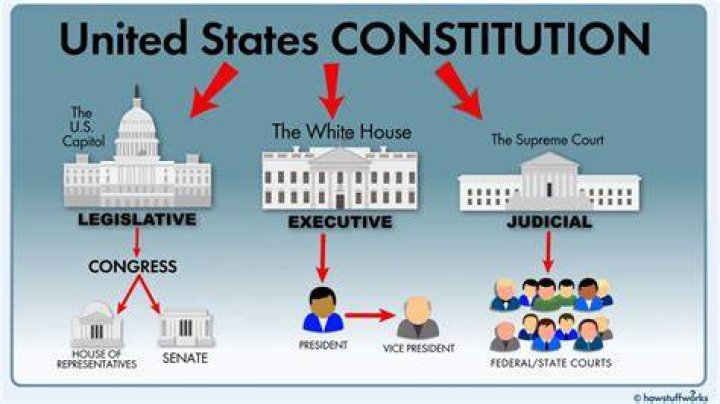
Similarly, do the three branches share power equally? The American system of government is established by the United States Constitution, which provides for three separate but equal branches of government--legislative, executive, and judicial. This "checks and balances" system means that the balance of power in our government remains steady.
Likewise, people ask, what are the three branches of government and their responsibilities?
The Constitution created the 3 branches of government:
- The Legislative Branch to make the laws. Congress is made up of two houses, the Senate and the House of Representatives.
- The Executive Branch to enforce the laws.
- The Judicial Branch to interpret the laws.
What is the most powerful branch of government?
The strongest branch of the United Starts government is the Judicial Branch. The Judicial Branch is the most powerful branch for a couple different reasons. First, the Judicial Branch has the power to declare the acts of the congress un-constitutional, and can declare acts of the executive branch, un-constitutional.
Related Question Answers
Which branch of government is the most powerful essay?
In conclusion, The Legislative Branch is the most powerful branch of the United States government not only because of the powers given to them by the Constitution, but also the implied powers that Congress has. There is also Congress's ability to triumph over the Checks and balances that limits their power.Who is the head of the legislative branch?
The presiding officer of the chamber is the Speaker of the House, elected by the Representatives. He or she is third in the line of succession to the Presidency.Who borrows money on behalf of the United States?
Clause 2. The Congress shall have Power * * * To borrow Money on the credit of the United States.What is a unitary system of government characterized by?
A unitary system of government, or unitary state, is a sovereign state governed as a single entity. The central government is supreme, and the administrative divisions exercise only powers that the central government has delegated to them. (The states themselves are unitary.)What are the 15 departments?
The Cabinet includes the Vice President and the heads of 15 executive departments — the Secretaries of Agriculture, Commerce, Defense, Education, Energy, Health and Human Services, Homeland Security, Housing and Urban Development, Interior, Labor, State, Transportation, Treasury, and Veterans Affairs, as well as theWhich branch of government interprets laws?
The judicial branch
Which is an implied power of the federal government?
Implied powers are political powers granted to the United States government that aren't explicitly stated in the Constitution. They're implied to be granted because similar powers have set a precedent. These implied powers are necessary for the function of any given governing body.What is the main job of each branch of government?
The executive branch (the executive departments and the President and cabinet at the federal level) makes sure that laws are enforced and allocates necessary funding. The judicial branch (the court system) evaluates the laws passed by the legislative branch and determines whether they comply with the Constitution.Who make the laws?
Federal laws are made by Congress on all kinds of matters, such as speed limits on highways. These laws make sure that all people are kept safe. The United States Congress is the lawmaking body of the Federal Government. Congress has two houses: the House of Representatives and the Senate.What are the 3 structures of government?
Through the first three Articles of the Constitution, the framers divided the new government into three parts. These three parts are known as the three branches of government. They are the legislative branch, the executive branch and the judicial branch.What are 3 examples of checks and balances?
Other checks and balances include the presidential veto of legislation (which Congress may override by a two-thirds vote) and executive and judicial impeachment by Congress. Only Congress can appropriate funds, and each house serves as a check on possible abuses of power or unwise action by the other.What is the major duty of the legislative branch?
The legislative branch is made up of the two houses of Congress—the Senate and the House of Representatives. The most important duty of the legislative branch is to make laws. Laws are written, discussed and voted on in Congress. There are 100 senators in the Senate, two from each state.Who is in charge of the judicial branch?
The judicial branch of the U.S. government is the system of federal courts and judges that interprets laws made by the legislative branch and enforced by the executive branch. At the top of the judicial branch are the nine justices of the Supreme Court, the highest court in the United States.What are the different types of branches?
Branches can be classified into two types.- Dependent Branches. The term dependent branch means a branch that does not maintain its own set of books.
- Independent Branch. An independent branch means a branch, which maintains its own set of books.