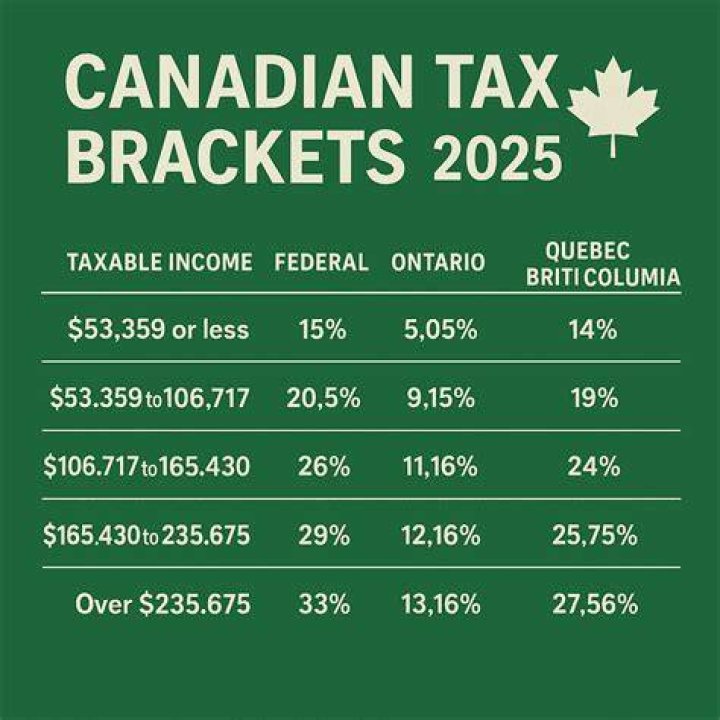
How much tax is deducted from salary in Canada?
 Rachel Davis
 .
Furthermore, how much tax is deducted from salary in Ontario?
Ontario: 5.05% on the first $43,906 of taxable income. 9.15% on portion of taxable income over $43,906 up-to $87,813.
Subsequently, question is, how much tax is deducted from a paycheck Ontario 2019? + 5.05% on the first $40,922 + 9.15% on the next $37,146 + 11.6% on the next $11,412 + 12.6% on every dollar after $149,999 in provincial tax. For example, if you made $52,000 annually, you would pay approximately $11,391.13 in income tax total including the federal and provincial taxes as outlined below.
Likewise, how much tax do you pay in Canada?
Federal Income Taxes In Canada, the range is 15% to 33%. In the U.S., the lowest tax bracket for the tax year ending 2019 is 10% for an individual earning $9,700 and jumps to 22% for those earning $39,476. The corresponding bottom Canadian bracket stays at 15% until $47,630.
How is tax calculated on salary?
Computing for Your Salary
- Taxable Income = (Monthly Basic Pay + Additional Pay) – (SSS + PhilHealth + PAG-IBIG + Deductions Due to Absences/Tardiness)
- Taxable Income = (23000) – (581.30 + ((23000 * 0.0275) / 2) + 100.00)
- Income Tax = (((Taxable Income * 12) – X) * Y) / 12.
Related Question Answers
How much tax is deducted?
Note: TDS should be deducted at applicable rates as above along with surcharge and Education Cess. Surcharge: 10% of income tax, where total income exceeds Rs. 50 lakh up to Rs. 1 crore.
TDS Rate Chart.
| Annual Income | Tax Rates |
|---|---|
| Up to Rs.5,00,000 | Nil |
| Rs.5,00,001-Rs.10,00,000 | 20% of income above Rs 5 lakhs |
How much can you earn before paying tax Canada?
Everyone who is a resident of Canada can claim the basic personal amount, which for federal purposes in 2016 was $11,474. That means that you can earn at least this amount of money before you need to start paying federal income taxes to the government.How is income tax deducted from salary?
Based on your total salary for the whole year and your investments in tax-saving products, your employer determines how much TDS has to be deducted from your salary each month. For a salaried employee, TDS forms a major portion of an employee's income tax payment. The bank deducts TDS at 10% on FDs usually.How do you calculate an annual salary?
Calculating an Annual Salary from an Hourly WageMultiply the number of hours you work per week by your hourly wage. Multiply that number by 52 (the number of weeks in a year). If you make $20 an hour and work 37.5 hours per week, your annual salary is $20 x 37.5 x 52, or $39,000.What percent is income tax?
The federal individual income tax has seven tax rates ranging from 10 percent to 37 percent (table 1). The rates apply to taxable income—adjusted gross income minus either the standard deduction or allowable itemized deductions.Are taxes high in Canada?
Taxes can also be a key differentiator for the two countries. Canada has a higher average practical tax rate than the United States at 28%. Business Insider reports that, after taxes Canadians bring home is roughly $35,500 annually on average. In the United States, the practical tax rate is lower at 18%.Are taxes higher in Canada or USA?
According to KPMG the corporate tax rate in Canada was 26.50% compared to 27% in the United States based on January 2018 data. Canada's 2017 debt-to-GDP ratio was 89.7%, compared to the United States at 107.8%. In 2016, Canada ranked 24th and the US 30th out of 35 OECD countries in terms of tax revenue to GDP ratio.Is healthcare free in Canada?
Canada's universal health-care systemIf you are a Canadian citizen or permanent resident, you may apply for public health insurance. With it, you don't have to pay for most health-care services. All provinces and territories will provide free emergency medical services, even if you don't have a government health card.Who pays the most taxes in Canada?
finds that this year, the top 20 per cent of income earners in Canada—families with an annual income greater than $186,875—will earn 49.1 per cent of all income in Canada but pay 55.9 per cent of all taxes including not just income taxes, but payroll taxes, sales taxes and property taxes, among others.Is college free in Canada?
Statistics Canada says it's $7,868. Yesterday the Ontario government claimed that most students from families making under $50,000 will be able to attend college or university for free in 2017. The government's math is based on the idea that average undergraduate university tuition costs $6,160.How can a high income earner reduce taxes in Canada?
Registered Disability Savings Plan.- Use RRSP space to reduce current taxes..
- Use a spousal plan to split RRSP income.
- Share CPP benefits.
- Split income with children through a Registered Education Savings Plan.
- Have the higher income spouse pay household expenses.
- Employ spouse or children.
What is the tax rate in Canada 2019?
The following are the federal tax rates for 2019 according to the Canada Revenue Agency (CRA): 15% on the first $48,535 of taxable income, and. 20.5% on the portion of taxable income over $48,535 up to $97,069 and. 26% on the portion of taxable income over $97,069 up to $150,473 and.How do taxes work in Canada?
How Are Canadian Taxes Calculated? In Canada, personal income taxes are calculated based on your income, minus the deductions for which you qualify, to arrive at a taxable income. From that income, you are taxed by the federal government and then by your provincial or territorial government.How do you calculate take home pay Ontario?
Formula for calculating net salary- Net annual salary / Weeks of work / year = Net weekly income.
- Net weekly income / Hours of work / week = Net hourly wage.
- $20 802.48 / 52 weeks = $400.05 / week (net)
- $400.05 / 40 hours = $10.00 / hour (net)
How do I calculate net from gross?
If you have a gross amount and want to determine the net value, then simply divide the gross value by 1.20 to provide the net value.How do I calculate my monthly income after taxes?
Calculating gross monthly income if you're paid hourlyFirst, to find your yearly pay, multiply your hourly wage by the number of hours you work each week, and then multiply the total by 52. Now that you know your annual gross income, divide it by 12 to find the monthly amount.How do you calculate take home pay?
In order to Calculate take-home salary, subtract the Income Tax, Provident Fund (PF) and Professional Tax from the Gross Salary.- Step 1: Calculate gross salary. Gross Salary = CTC – (EPF + Gratuity)
- Step 2: Calculate taxable income.
- Step 3: Calculate income tax**
- Step 4: Calculating in-hand/take home salary.
How do I calculate CPP and EI?
Calculating the EI Contribution- Multiply the annual salary up to the maximum amount by the factor provided by the CRA.
- Divide the result by 12 to get the monthly deduction.