What changed during ww1? | ContextResponse.com
 Mia Horton
 .
Similarly, you may ask, what changed after ww1?
Nations that gained or regained territory or independence after World War I. France: gained Alsace-Lorraine as well as various African colonies from the German Empire, and Middle East territories from the Ottoman Empire. The African and Middle East gains were officially League of Nations Mandates.
Also, what were the outcomes of World War 1? World War I was one of the great watersheds of 20th-century geopolitical history. It led to the fall of four great imperial dynasties (in Germany, Russia, Austria-Hungary, and Turkey), resulted in the Bolshevik Revolution in Russia, and, in its destabilization of European society, laid the groundwork for World War II.
Considering this, how did World War 1 changed history?
On 11 November 1918, the guns fell silent and the war came to an end, but its impact was felt for many, many years after. World War One changed the world in ways that nobody could have imagined. New weapons and technologies were developed and used that led to more destruction than any war had seen in the past.
What happened after World War 1?
Germany had formally surrendered on November 11, 1918, and all nations had agreed to stop fighting while the terms of peace were negotiated. On June 28, 1919, Germany and the Allied Nations (including Britain, France, Italy and Russia) signed the Treaty of Versailles, formally ending the war.
Related Question Answers
What did ww1 accomplish?
It changed americas military production systems, advanced aircraft to great heights. As well changed the way war was fought. You rarely find a war today between two countries fighting for huge amounts of land dominance. You will find us fighting for land, for land is wealth, but not on the level of our forbears.Why is ww1 important?
The First World War brought the destruction to Empires such as French Colonial Empire, British Empire and Ottoman Empire… The damage of the war caused these countries to lose grasp of their power. Those countries have put significant efforts in improving their weapons, which means more destruction.What countries no longer existed after ww1?
The Austro-Hungarian Dual Monarchy (aka Empire) disappeared entirely becoming the the nation states of, or partial nation states of, or loss of land to: Czechoslovakia, Austria, Hungary, Yugoslavia, Poland, Italy, Romania.What were the long term effects of ww1?
The long and short term causes of World War 1 had an impact on many people during and after the 1914's. Alliances, Imperialism, Militarism and Nationalism were only four things but there are more such as people and assassinations.How did WWI lead to World War 2?
Below are some of the main causes of World War 2. The Treaty of Versailles ended World War I between Germany and the Allied Powers. Because Germany had lost the war, the treaty was very harsh against Germany. The treaty required that Germany pay a huge sum of money called reparations.What were the negative effects of ww1?
World War 1 had many negative effects. The suffering caused to many because so many soldiers and civilians were killed (approx. 17 million deaths and 20 million wounded). Also diseases flourished due to the war which led to an even greater death toll (1918 influenza breakout).Who won World War 1?
The Allies (mainly Britain, France, US) won WW1 which happened from 1914-1919. Germany was the main loser, along with Austria - Hungary, The Ottoman Empire, and the other Central Powers and also Russia, although Russia withdrew from the war early due to civil war issues at home.How did ww1 change women's lives?
Women's work in WW1During WWI (1914-1918), large numbers of women were recruited into jobs vacated by men who had gone to fight in the war. New jobs were also created as part of the war effort, for example in munitions factories.What was the reason for World War 1?
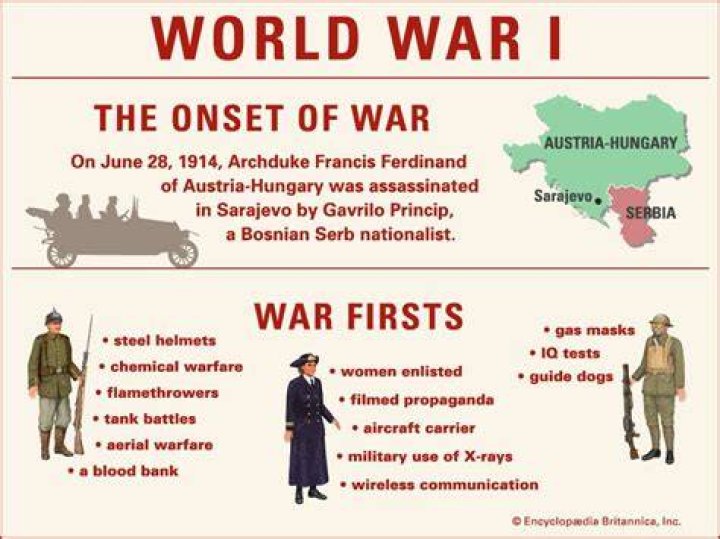
The real causes of World War I included politics, secret alliances, imperialism, and nationalistic pride. However, there was one single event, the assassination of Archduke Ferdinand of Austria, which started a chain of events leading to war.How was Britain affected by ww1?
The First World War had a profound impact upon British society. The central agent of change was the British state. In the early stages of the war, its role was largely confined to security issues such as the Defence of the Realm Act, censorship and aliens. But from 1915 onwards, state power was extended into new areas.Why did the 1st World War happen?
The immediate cause of World War I that made the aforementioned items come into play (alliances, imperialism, militarism, nationalism) was the assassination of Archduke Franz Ferdinand of Austria-Hungary. When Russia began to mobilize due to its alliance with Serbia, Germany declared war on Russia.Who started World War 2?
On September 1, 1939, Hitler invaded Poland from the west; two days later, France and Britain declared war on Germany, beginning World War II. On September 17, Soviet troops invaded Poland from the east.How World War 2 changed the world?
The large-scale ways in which WWII changed the world are well-known: the Holocaust's decimation of Jewish people and culture, the use of atomic bombs on Japan, and the wide swath of death and destruction caused by the Axis powers in Europe. But there are also more indirect ways that WWII impacted modern society.How long was World War 2?
about six years