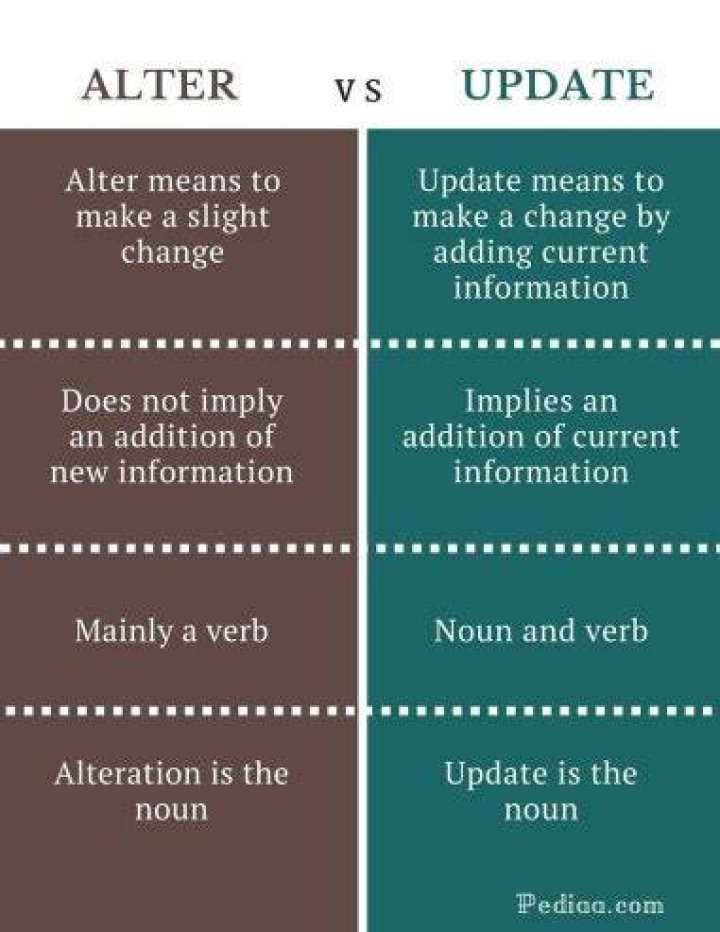
What is the difference between alter and update?
 Isabella Harris
 .
Keeping this in view, what is the difference between Alter and drop?
Summary. The alter command is used when we want to modify a database or any object contained in the database. The drop command is used to delete databases from MySQL server or objects within a database. The rename command is used to change the name of a table to a new table name.
Secondly, is alter a DML statement? Basically, any CREATE/DROP/ALTER command is DDL. DML - alter the information/data within the schema; without updating the schema. This includes DELETE and UPDATE statements.
Regarding this, what is the difference between an insert command and an update command?
The main difference between INSERT and UPDATE in SQL is that INSERT is used to add new records to the table while UPDATE is used to modify the existing records in the table. These commands help to manipulate the data stored in the tables. INSERT and UPDATE are two DML commands.
What is difference between delete truncate and drop commands in SQL?
TRUNCATE removes all rows from a table. The operation cannot be rolled back and no triggers will be fired. DROP and TRUNCATE are DDL commands, whereas DELETE is a DML command. Therefore DELETE operations can be rolled back (undone), while DROP and TRUNCATE operations cannot be rolled back.
Related Question Answers
Can we rollback truncate?
You cannot ROLLBACK TRUNCATESimply, you cannot rollback a transaction if it is already committed but you can do something else to get the data back (or at least some parts of it). When you execute the TRUNCATE statement, your data is still in the MDF file.Why use truncate instead of delete?
TRUNCATE TABLE is faster and uses fewer system resources than DELETE , because DELETE scans the table to generate a count of rows that were affected then delete the rows one by one and records an entry in the database log for each deleted row, while TRUNCATE TABLE just delete all the rows without providing anyIs truncate faster than delete?
TRUNCATE removes all rows from a table. Minimal logging in transaction log, so it is faster performance wise. TRUNCATE TABLE removes the data by deallocating the data pages used to store the table data and records only the page deallocations in the transaction log. TRUNCATE is faster than DELETE.Which is faster truncate or drop?
TRUNCATE is faster than DROP because DROP does double work - First it removes data and secondly it removes the structure of table where as truncate does only one work - it just deletes the data.What does truncate do?
TRUNCATE. TRUNCATE statement is a Data Definition Language (DDL) operation that is used to mark the extents of a table for deallocation (empty for reuse). The result of this operation quickly removes all data from a table, typically bypassing a number of integrity enforcing mechanisms.Does truncate remove indexes?
The truncate command only removes all rows of a table. It does not remove the columns, indexes, constraints, and schema.Why truncate is DDL?
First, to your question, TRUNCATE is a DDL command, DELETE is a DML command. This is because TRUNCATE actually drops & re-creates the table, and resets the table's metadata (this is why TRUNCATE does not support a WHERE clause). TRUNCATE is most often used while loading staging tables during data import processes.What are the DML commands?
Some commands of DML are:- SELECT – retrieve data from the a database.
- INSERT – insert data into a table.
- UPDATE – updates existing data within a table.
- DELETE – deletes all records from a table, the space for the records remain.
- MERGE – UPSERT operation (insert or update)
- CALL – call a PL/SQL or Java subprogram.