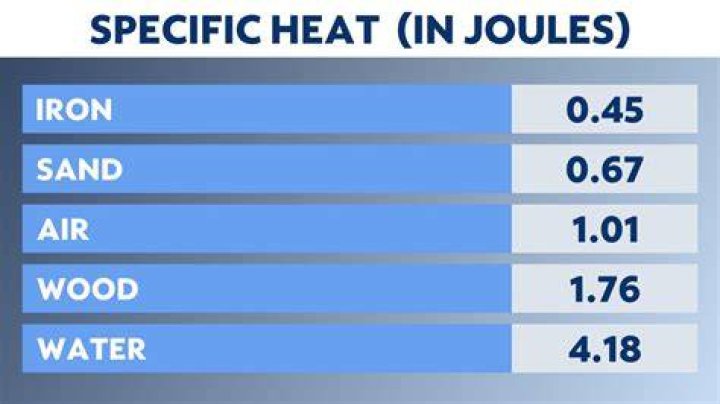
What is the specific heat capacity for sand?
 Daniel Davis
 • disabling your adblocker on The Engineering ToolBox! •• How to?
| Substance | Specific Heat - cp - (J/kgoC) |
|---|---|
| Rosin | 1300 |
| Rubidium | 330 |
| Salt, NaCl | 880 |
| Sand, quartz | 830 |
.
In this regard, what is the specific heat of sand?
Being primarily silica and quartz grains the specific heat of “sand” would be approximately 0.24 BTU per pound per degree Fahrenheit. (Imperial Units) The actual number will vary depending upon the specific mineral makeup of the variety of sand. Some sand is primarily calcium carbonate from seashells.
Subsequently, question is, what is the specific heat capacity of wood? The heat storing capacity of wood depends on its density, moisture content, temperature and the direction of the grain. The average specific heat value of pine and spruce at +0 – 100 C is 2,300 J/kgoC.
Keeping this in view, which has a higher specific heat water or sand?
The sand should both heat and cool faster than the water. This is because water has a higher specific heat ca- pacity than sand – meaning that it takes a lot of heat, or energy, to raise the temperature of water one degree, whereas it takes comparatively little energy to change the temperature of sand by one degree.
What is the specific heat capacity of metal?
| Specific Heat Capacity of Metals Table Chart | ||
|---|---|---|
| Metal | Btu/(lb-°F) | J/(kg-K) |
| Chromium | 0.110 | 460.548 |
| Cobalt | 0.100 | 418.68 |
| Copper | 0.090 | 376.812 |
Related Question Answers
What is specific heat example?
Definition: Specific heat is the amount of heat per unit mass required to raise the temperature by one degree Celsius. SYMBOL to denote it is c. Now best example to Specific heat is Water, for water specific heat is 1. real life example of specific heat: water takes more time to heat up and cool down.What is the formula for specific heat?
Specific heat is the amount of heat required to raise one gram of any substance one degree Celsius or Kelvin. The formula for specific heat is the amount of heat absorbed or released = mass x specific heat x change in temperature.What is the specific heat of water?
The specific heat of water is 1 calorie/gram °C = 4.186 joule/gram °C which is higher than any other common substance. As a result, water plays a very important role in temperature regulation.What is the highest specific heat capacity?
Water has the highest specific heat capacity of any liquid. Specific heat is defined as the amount of heat one gram of a substance must absorb or lose to change its temperature by one degree Celsius. For water, this amount is one calorie, or 4.184 Joules.What material has the highest specific heat capacity?
Liquid water has one of the highest specific heats among common substances, about 4182 J/K/kg at 20 °C; but that of ice just below 0 °C is only 2093 J/K/kg. The specific heats of iron, granite, oak wood, and hydrogen gas are about 449, 790, 2400, and 14300 J/K/kg, respectively.What is the specific heat of ethylene glycol?
about 3140 J
What is the value of specific heat capacity?
In ?SI units, specific heat capacity (symbol: c) is the amount of heat in joules required to raise 1 gram of a substance 1 Kelvin. It may also be expressed as J/kg·K. Specific heat capacity may be reported in the units of calories per gram degree Celsius, too.Can specific heat capacity be negative?
If the system loses energy, for example, by radiating energy into space, the average kinetic energy actually increases. If a temperature is defined by the average kinetic energy, then the system therefore can be said to have a negative heat capacity. A more extreme version of this occurs with black holes.Does sand have a high specific heat?
Specific heat is how much heat energy is needed raise the temperature of a substance. Water has a very high specific heat. Sand and asphalt, on the other hand, have lower specific heats. This means that their temperatures change more quickly.Does anything have a higher specific heat than water?
Generally anything denser than water will have a higher heat capacity, such as oil. Heat water and the highest the temperature goes is 212F, assuming sea level and pure water. But now heat oil and you'll see the temperature goes well above 212F.What is the specific heat capacity of salt water?
Or rather, different amounts of energy is needed to heat different materials. Water has a specific heat capacity of 4.18 kJ/kgK while salt (NaCl) has a specific heat capacity of 0.88 kJ/kgK. When salt is dissolved in water, it changes several properties, one of which is the specific heat capacity.What is the specific heat of water in JGC?
Because there are 4.184 joules in a calorie, the specific heat of water is 4.184 J/g-K. The ease with which a substance gains or loses heat can also be described in terms of its molar heat capacity, which is the heat required to raise the temperature of one mole of the substance by either 1oC or 1 K.What is specific heat capacity of aluminum?
The specific thermal capacity of aluminium is 900 J/kg °C. The specific thermal capacity of water is 4200 J/kg °C. It takes more energy to raise the same temperature of water by each °C than it does to raise the temperature of the same mass of aluminium.What is the specific heat of chromium?
Specific heat of Chromium is 0.45 J/g K. Latent Heat of Fusion of Chromium is 16.9 kJ/mol.What is the specific heat of solid aluminum?
Specific heats and molar heat capacities for various substances at 20 C
| Substance | c in J/gm K | c in cal/gm K or Btu/lb F |
|---|---|---|
| Aluminum | 0.900 | 0.215 |
| Bismuth | 0.123 | 0.0294 |
| Copper | 0.386 | 0.0923 |
| Brass | 0.380 | 0.092 |
Which metal has the highest specific heat?
Which metal heats up fastest, Aluminum, Copper, or Silver?- 100.
- Specific heat capacity: Aluminum 0.91 J/g°C Copper 0.39 J/g°C Silver 0.240 J/g°C Lead 0.160 J/g°C.
- Specific heat capacity means the amount of heat required to raise the temperature of 1 grams of substance by 1 °C.