Where can we find Kupffer cells and what is their main function?
 Rachel Davis
 .
Correspondingly, where are Kupffer cells and what do they do?
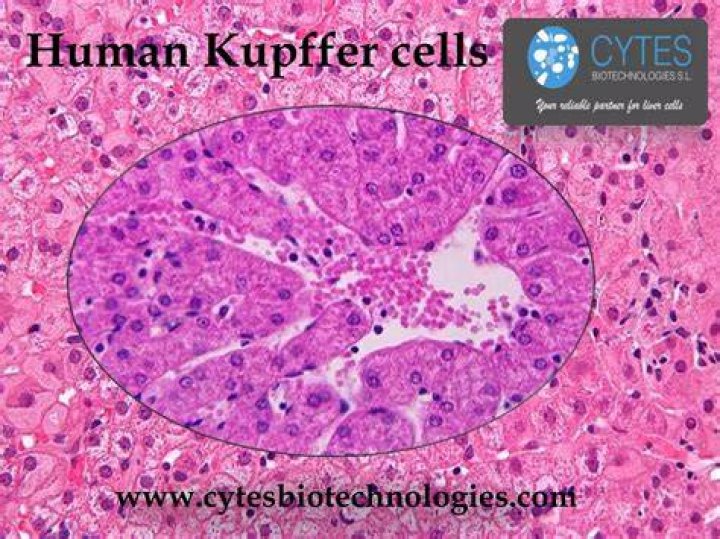
Liver biopsy. Trichrome stain. Kupffer cells, also known as stellate macrophages and Kupffer–Browicz cells, are specialized macrophages located in the liver, lining the walls of the sinusoids. They form part of the mononuclear phagocyte system.
Additionally, do Kupffer cells produce bile? Bile is a mixture of water, bile salts, cholesterol, and the pigment bilirubin. Hepatocytes in the liver produce bile, which then passes through the bile ducts to be stored in the gallbladder. Kupffer cells in the liver catch and destroy old, worn out red blood cells and pass their components on to hepatocytes.
Moreover, what do Kupffer cells store?
The sinusoids are microscopic blood channels. The Kupffer cells are phagocytic, i.e., capable of ingestion of other cells and of foreign particles. They also store hemosiderin so that it is available for the production of hemoglobin, the oxygen-transporting component of the red blood cell.
What is the function of stellate macrophages?
The stellate macrophages are also called Browicz-Kupffer cells, which are specific macrophages present in the liver. The Kupffer cells engulf the pathogens, damaged blood cells and cell debris. They also store the iron in the liver, which is absorbed by the digestive tract.
Related Question Answers
Where are phagocytes found?
Professional Phagocytes
| Main location | Variety of phenotypes |
|---|---|
| Blood | neutrophils, monocytes |
| Bone marrow | macrophages, monocytes, sinusoidal cells, lining cells |
| Bone tissue | osteoclasts |
| Gut and intestinal Peyer's patches | macrophages |
How do hepatocytes work?
Hepatocyte. Liver cells, or hepatocytes, have direct access to the liver's blood supply through small capillaries called sinusoids. Hepatocytes carry out many metabolic functions, including the production of bile.What side is your liver on?
right
What do stellate cells do?
In addition to their role in responding to hepatic injury, stellate cells in the healthy liver are the major storage site in the body for vitamin A. Stellate cells provide the liver with an ability to respond to injury and heal certain types of damage.What is the function of the sinusoids and what do they contain?
Sinusoids are low pressure vascular channels that receive blood from terminal branches of the hepatic artery and portal vein at the periphery of lobules and deliver it into central veins. Sinusoids are lined with endothelial cells and flanked by plates of hepatocytes.Where can you find macrophages?
Macrophages can then be found in many areas in the body, like different tissues, lungs, skin, and also organs of the immune system like the spleen, lymph nodes, and bone marrow.How do macrophages work?
The macrophage is a large white blood cell that is an integral part of our immune system. Its job is to locate microscopic foreign bodies and 'eat' them. Macrophages use the process of phagocytosis to engulf particles and then digest them.How many livers does a human body have?
one liver
What type of cells remove pathogens in the liver?
Two articles in this issue of Cell Host & Microbe (Broadley et al., 2016, Zeng et al., 2016) identify new mechanisms by which resident liver macrophages (Kupffer cells) rapidly capture bacteria from the blood and eliminate them, while still allowing for the induction of adaptive immunity.What is the portal triad?
portal triad (plural portal triads) (anatomy) A distinctive component of a hepatic lobule, found running along each of the lobule's corners, that consists of branches of the hepatic artery proper, hepatic portal vein and bile ducts, as well as other structures.What cell is the precursor of macrophages?
monocytes
What is the name of the disease where liver tissue is replaced by scar tissue?
Cirrhosis